
Hartford County Arrest Records and Charges
Hartford County arrest records begin on the law-enforcement side. The Hartford Police daily arrest log is the local source identified in the research for City of Hartford arrest entries. It may show the case number, arrest number, arrest date and time, arrest type, location, arrestee name, date of birth, age, sex, race, physical descriptors, address, charges, and officer names. That log is useful, but it is not the same as a court case file.
Court charges after arrest begin when the prosecutor decides what charge should move forward in Superior Court. Connecticut uses State's Attorneys, not county district attorneys. The Office of the State's Attorney for the Judicial District of Hartford is the charging office tied to Hartford Judicial District criminal matters. Once filed, charges are tracked in Judicial Branch criminal and motor vehicle systems by defendant name, docket number, court location, and case status. For custody status, use the statewide DOC search rather than a county jail roster.
The charge record can differ from the arrest log. Police may list charges at arrest, but the court docket later shows filed charges, amendments, nolles, dismissals, pleas, convictions, sentencing, bond events, and warrant events. The full criminal case file belongs on the Hartford County criminal court records path, while arrest and booking context belongs with police and inmate sources.
Search Hartford County Arrest Records
The official search path starts with the record type. Police arrest logs identify the arrest event. The Judicial Branch Criminal/Motor Vehicle Case Look-up identifies pending court charges, convictions, daily dockets, and warrant links. Hartford County does not run a county criminal-record portal, and the Clerk of the Superior Court is the court-record office for Superior Court files.
- Check the Hartford Police arrest log when the arrest was made by Hartford Police and a daily log is available.
- Open the Judicial Branch criminal and motor vehicle lookup for pending cases or conviction searches.
- Search by defendant name or docket number, then use court location filters such as Hartford GA 14, Hartford JD, Hartford Community Court, Manchester GA 12, or New Britain GA 15 when known.
- Read each charge line with its status, court location, disposition, and sentence information when the public display includes it.
- Contact the clerk at the court location for older files, certified copies, sealed-file questions, or documents not shown online.
The pending criminal defendant search requires a last name that begins with the entered text. First initial, birth year, year range, court location, and category type are optional filters. The conviction display is more limited. Judicial Branch notices state that conviction information is generally shown for no more than ten years after sentencing unless Practice Book Section 7-13 gives a shorter display period.
Hartford County Charges After Arrest
A charge record is built from the charging decision, not just from the arrest. The Hartford Police log may use charge text from the arrest event. The State's Attorney and the Superior Court docket show whether a complaint, information, or indictment moved into court and how it changed. Connecticut practice uses prosecutor filings and court docket entries, so the exact label on a public result may vary by case type and stage.
| Charging document | Who drives it | How it matters in Hartford County |
|---|---|---|
| Complaint | Law enforcement or prosecutor | Often reflects the first court-facing accusation after an arrest or summons. |
| Information | State's Attorney | Sets out the formal charges the prosecutor is pursuing in Superior Court. |
| Indictment | Grand jury or higher-level charging process | May appear in serious matters, but routine Hartford criminal searches are usually handled through Judicial Branch criminal lookup and the clerk. |
The U.S. Attorney's Office for the District of Connecticut appears in federal criminal matters, not state Superior Court prosecutions. Use federal sources only when the arrest leads to a federal case. For most Hartford-area state charges, the Superior Court and State's Attorney channels are the correct path.
The official U.S. Attorney's Office source helps separate federal prosecution from state charges.
Use that federal source only when a Hartford arrest becomes a District of Connecticut case rather than a Connecticut Superior Court matter.
Hartford County Charge Status
Charge status is the part of Hartford County court charge records that often matters most. A charge can be pending at arraignment, amended after review, reduced during negotiations, dismissed by court action, or nolled by the prosecutor. A nolle means the prosecutor is not pursuing the charge at that time. It is not the same word as acquittal, and it should not be read as a conviction.
| Status | What It Means | Where to confirm it |
|---|---|---|
| Pending | The charge remains active and has not reached a final disposition. | Pending criminal/motor vehicle lookup or the issuing court clerk. |
| Amended or reduced | The filed charge changed from an earlier charge or was replaced with a lesser charge. | Case docket, disposition line, and clerk copy of the file. |
| Dismissed | The court ended the charge without a conviction. | Disposition entry and clerk record. |
| Nolle | The prosecutor declined to pursue the charge at that time. | Disposition entry in the criminal case record. |
| Conviction | A guilty finding or plea resulted in a sentence or court-imposed outcome. | Conviction search, docket record, and sentencing entry. |
Note: Online criminal history can change because of erasures, corrections, pardons, and other post-disposition modifications.
Hartford County Charges vs Convictions
A charge is an accusation. A conviction is the result of a guilty plea, court finding, or verdict. Hartford County arrest records can name charges that never become convictions. The Judicial Branch criminal/motor vehicle conviction display also excludes some categories, including youthful offender cases, juvenile cases, and infraction or violation convictions.
| Point of comparison | Charge | Conviction |
|---|---|---|
| Stage | Filed after arrest or summons, before final outcome. | Entered after plea, finding, or verdict. |
| Meaning | An allegation that still may change. | A resolved finding of guilt with a sentence or penalty. |
| Public display | May appear in pending case records or daily dockets. | May appear in conviction search, subject to display limits. |
| Best source | Pending case lookup and clerk record. | Conviction lookup and certified court disposition. |
Hartford County Arrest Access Laws
Connecticut public access starts with the record holder. The Connecticut Freedom of Information Act allows requests to public agencies unless an exemption applies. For court charges, that path is different because Superior Court case access follows Judicial Branch systems, Practice Book display rules, and clerk procedures. For police logs and police reports, the agency holding the report is the request target.
Key access rule: FOI is a fallback for agency records, but court files, police reports, DOC records, and DMV records each use their own official channel.
Criminal procedure and erasure rules are in Connecticut General Statutes Title 54. That source is important for arrest, charge, warrant, erasure, and post-disposition record issues.
The official Connecticut criminal procedure statutes are the source for many charge, warrant, and erasure rules.
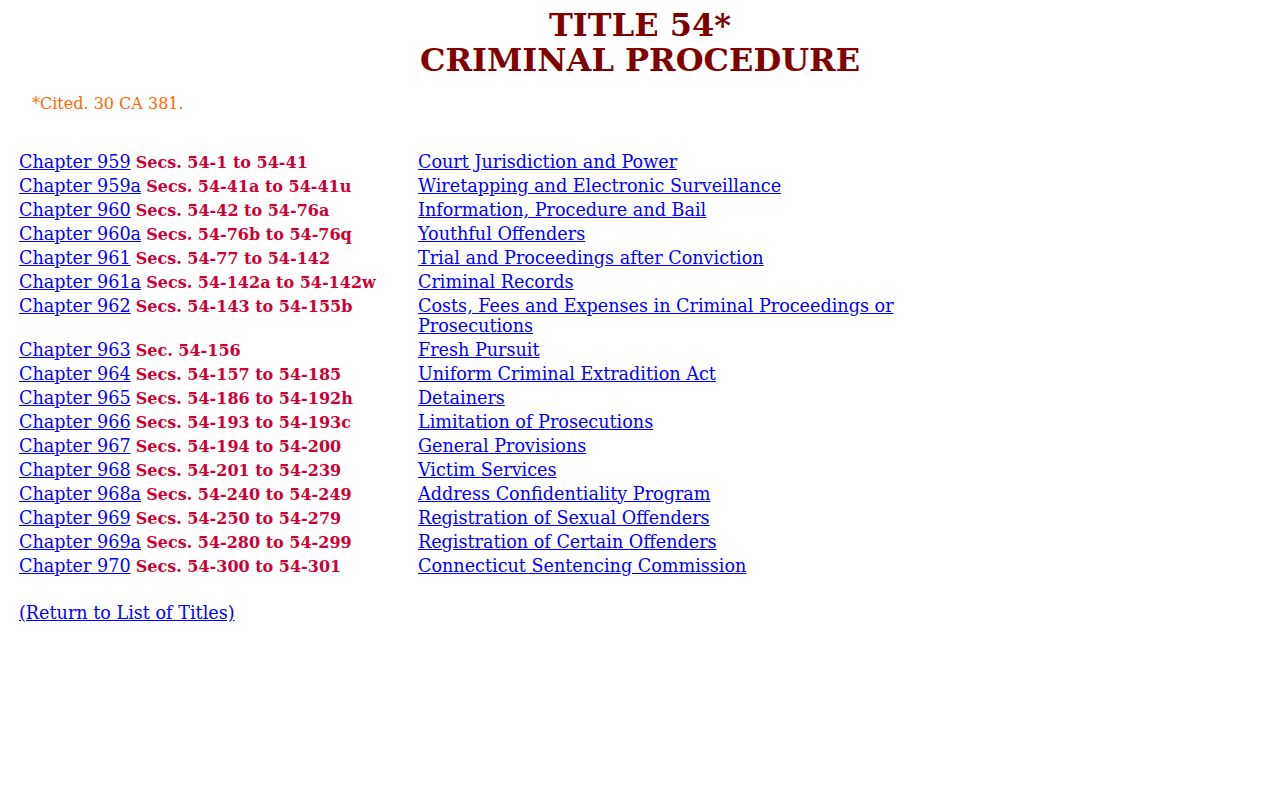
Those statutes support the difference between a public charge lookup and a final legal conclusion about record erasure or restriction.
Restricted Hartford County Charge Records
Not every Hartford County arrest or charge record is open. Juvenile and youthful offender matters are generally restricted. Sealed and erased records can be removed from ordinary public view. Adoption, mental-health, protected-address, Social Security number, financial account, and minor-identity details are also redacted or withheld when the law requires it.
| Record type | Public effect | Practical search result |
|---|---|---|
| Sealed record | Closed to general public access by order or rule. | The portal may show limited detail or no usable detail. |
| Erased record | Removed from ordinary public criminal history under Connecticut rules. | The public display may no longer show the case. |
| Juvenile or youthful offender | Restricted by law and not shown in public conviction display. | General public searches usually will not return full records. |
Eligibility for erasure, sealing, or pardon relief depends on the charge, disposition, time since conviction or discharge, and whether another case is pending. Confirm the docket number, charge statute, conviction date, and disposition before relying on a public search result.